
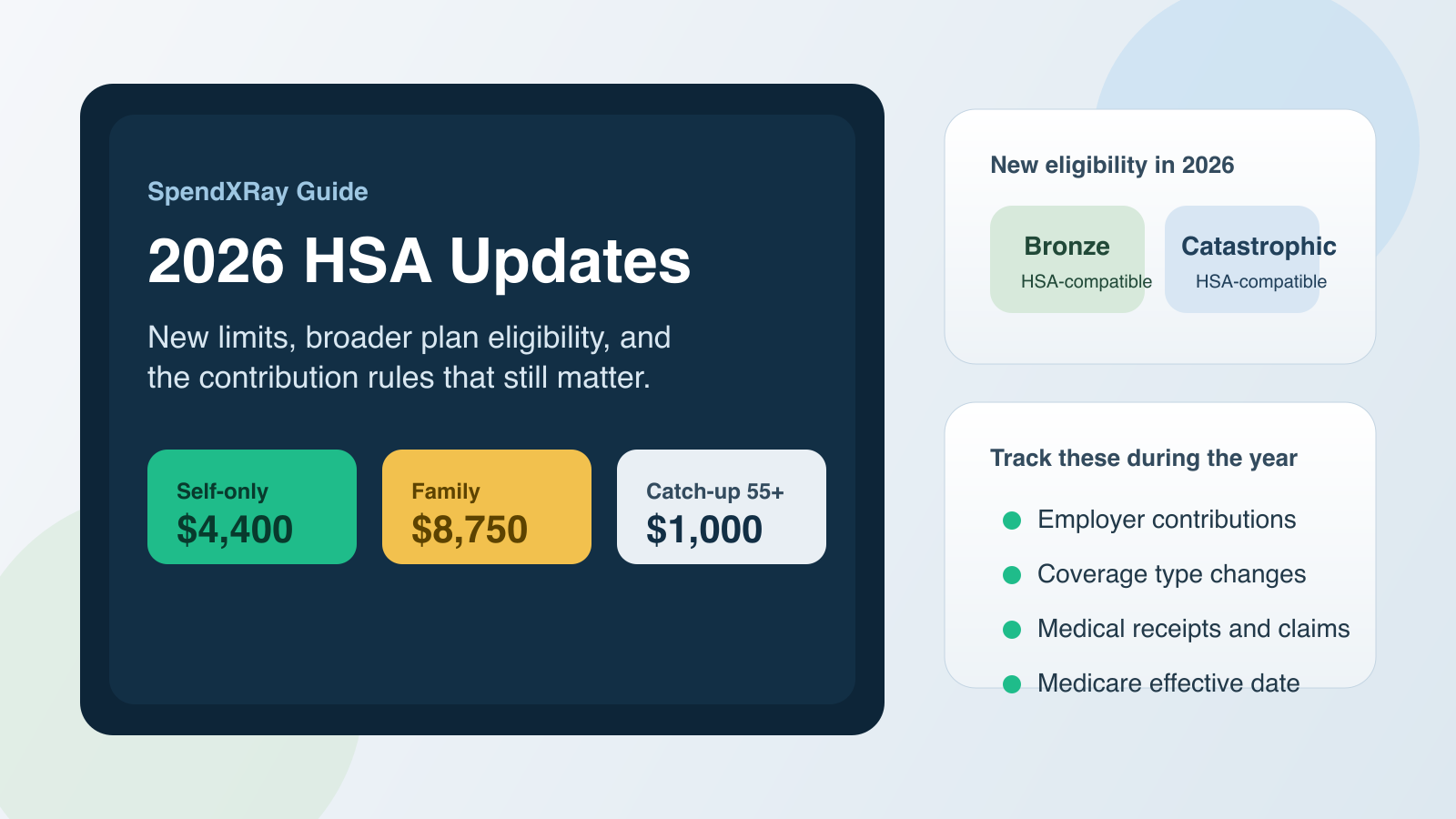
2026 HSA Contribution Limits and New Plan Rules: What Changed for Bronze, Catastrophic, and HDHP Coverage
The 2026 HSA update is bigger than a routine limit increase. Here is what changed, who may newly qualify, and how to avoid contribution mistakes.
HSA rules changed in meaningful ways for 2026, and this is one of those years where using last year's assumptions can lead to a bad payroll election or a missed eligibility opportunity. The IRS raised the 2026 contribution limits, adjusted the high-deductible health plan thresholds, and new federal guidance expanded HSA compatibility to all 2026 Bronze and Catastrophic plans. For people comparing coverage, setting paycheck contributions, or tracking medical spending more carefully, those changes matter now.
2026 HSA limits at a glance
| Item | 2025 | 2026 |
|---|---|---|
| HSA contribution limit, self-only coverage | $4,300 | $4,400 |
| HSA contribution limit, family coverage | $8,550 | $8,750 |
| Minimum HDHP deductible, self-only coverage | $1,650 | $1,700 |
| Minimum HDHP deductible, family coverage | $3,300 | $3,400 |
| Maximum out-of-pocket limit, self-only coverage | $8,300 | $8,500 |
| Maximum out-of-pocket limit, family coverage | $16,600 | $17,000 |
If you are age 55 or older by the end of the tax year, the additional catch-up contribution remains $1,000. That catch-up amount is separate from the main annual limit.
What changed beyond the dollar limits
All 2026 Bronze and Catastrophic plans can work with HSAs
This is the biggest practical change for many shoppers. HealthCare.gov now states that all 2026 Bronze and Catastrophic health plans are eligible for Health Savings Accounts. IRS Notice 2026-5 explains that, beginning with months after December 31, 2025, Bronze and Catastrophic plans are treated as HSA-compatible even if they would not have satisfied the older HDHP tests on their own.
That means some people who previously could not contribute to an HSA may be able to do so in 2026 if they enrolled in one of those plans and do not have other disqualifying coverage. It also means open-enrollment comparisons should look different than they did a year ago.
Telehealth before the deductible no longer breaks HSA eligibility
The IRS says the telehealth and remote-care safe harbor is now permanent for plan years beginning on or after January 1, 2025. In plain terms, an HDHP can cover telehealth or other remote-care services before the deductible without automatically making the enrollee ineligible to contribute to an HSA.
That matters if you use virtual primary care, mental health visits, or online urgent care and had been worried that first-dollar telehealth coverage might interfere with HSA eligibility.
Some direct primary care arrangements no longer block HSA contributions
Starting January 1, 2026, certain direct primary care service arrangements do not count as disqualifying coverage for HSA contribution purposes. Notice 2026-5 says the arrangement must be limited to primary care services for a fixed periodic fee, and the monthly aggregate fee cannot exceed $150 for one individual or $300 for an arrangement covering more than one individual. Those dollar caps will be adjusted for inflation after 2026.
The same notice also says HSA funds may be used tax-free to reimburse fees for direct primary care arrangements that meet the statutory rules. This is helpful, but it is also an area where plan details matter. A membership-style program that bills separately for additional services may not fit the safe definition.
What did not change
- You still need to be HSA-eligible for the months you contribute. New plan categories help, but they do not eliminate the rest of the eligibility rules.
- Employer contributions still count toward the annual limit. If your employer seeds your HSA, subtract that amount before setting your own payroll election.
- Medicare enrollment still matters. IRS Publication 969 says your HSA contribution limit becomes zero starting with the first month you are enrolled in Medicare, and retroactive Medicare coverage can create excess contributions.
- The last-month rule still exists, but it comes with a testing-period risk. If you use it to make a full-year contribution based on being eligible on December 1, you generally need to stay eligible through the testing period or part of that contribution can become taxable and subject to an additional tax.
How to set your 2026 HSA contribution without overfunding
- Confirm your 2026 coverage type. Start with whether you have self-only or family coverage for the months you will actually be HSA-eligible.
- Check for other coverage that could disqualify you. The new Bronze, Catastrophic, telehealth, and direct-primary-care rules help, but they do not override every other eligibility restriction.
- Use the correct annual limit. For 2026, that is $4,400 for self-only coverage and $8,750 for family coverage.
- Add catch-up only if you qualify. If you are 55 or older by year-end, add $1,000.
- Subtract employer money. Employer and payroll contributions all count toward the same annual ceiling.
- Adjust for partial-year eligibility. If you gain Medicare, lose HDHP coverage, or otherwise stop being eligible during the year, your contribution limit may need to be prorated unless you deliberately use the last-month rule and understand the follow-on testing period.
Three common 2026 scenarios
| Scenario | What to watch | Practical action |
|---|---|---|
| You chose a 2026 Bronze Marketplace plan | That plan may now be HSA-compatible even if a similar Bronze plan was not HSA-compatible before. | Recheck your eligibility and update your payroll or direct contribution plan instead of assuming you are excluded. |
| Your employer contributes to your HSA | Your own election plus the employer contribution cannot exceed the annual limit. | Record the employer amount early in the year so you do not over-contribute by accident. |
| You are approaching Medicare enrollment | Publication 969 warns that Medicare can reduce your allowed contribution months, including because of retroactive coverage. | Coordinate your final HSA contribution schedule before enrollment takes effect. |
What to track if you use SpendXRay or any other spending system
The article-worthy part of these rule changes is not just the headline number. It is the tracking work they create. A simple system should keep four things separate:
- your plan type and the months you were actually HSA-eligible;
- your own contributions versus employer contributions;
- medical purchases and reimbursement records; and
- any plan-status changes that affect eligibility, such as Medicare enrollment or a move into a new coverage tier.
That structure makes it much easier to explain where your HSA money came from, why a contribution amount was correct, and which receipts you may want later for reimbursement or documentation.
What to do next
- Check whether your 2026 plan is self-only or family coverage and whether it is HSA-eligible under the current rules.
- If you are on a Bronze or Catastrophic plan, revisit any assumption that you cannot use an HSA in 2026.
- Update your payroll election using the 2026 limit and subtract any employer contribution.
- If you use telehealth or direct primary care, verify that your arrangement fits the current IRS guidance before relying on HSA eligibility.
- Track receipts and reimbursement records in the same system you use to track contributions, so your tax and spending records stay aligned.
Conclusion
The 2026 HSA update is not just a routine inflation adjustment. The annual limits increased, but the bigger operational change is that far more shoppers may now be able to pair HSAs with Bronze or Catastrophic coverage. If you set your contribution schedule using 2025 assumptions, it is worth rechecking your plan now.
Sources
- IRS Rev. Proc. 2025-19: 2026 HSA inflation-adjusted amounts
- IRS Publication 969: Health Savings Accounts and Other Tax-Favored Health Plans
- IRS Notice 2026-5: Expanded availability of HSAs
- IRS newsroom summary of Notice 2026-5
- HealthCare.gov: What are Health Savings Account-eligible plans?
- HealthCare.gov: Catastrophic health plans