
Card Statement vs Receipt: What Proof You Need for Returns, HSA/FSA Claims, and Tax Records
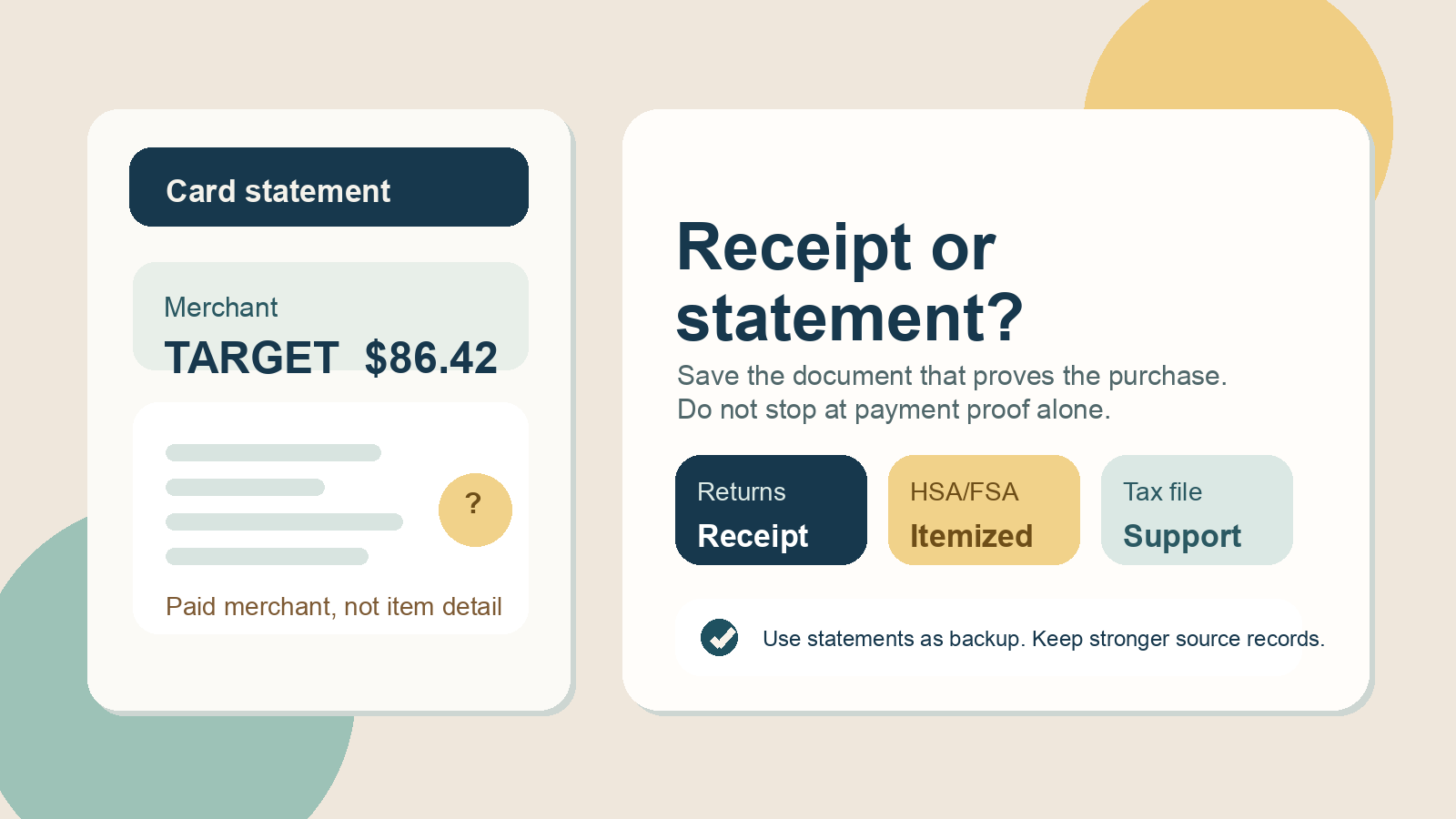
A card statement proves that you paid a merchant. It usually does not prove what you bought. Here is what to save for returns, HSA/FSA documentation, and tax recordkeeping.
A card statement can prove that money left your account. It usually cannot prove what you bought, whether the item was eligible for a return, or whether a medical expense was properly substantiated for an HSA or health FSA. That distinction matters more than most people realize because the documents that help with one task often fail at another.
This matters now because more purchases are split across apps, retailer accounts, card statements, digital barcodes, and emailed confirmations. If you wait until a return, reimbursement, or tax question comes up, you usually find out too late that you saved the wrong document. The better approach is to know which record proves what before you need it.
Quick answer: which document works for which job?
| Use case | Is a card statement enough? | What usually works better | Why |
|---|---|---|---|
| Retail return or exchange | No, usually not by itself | Store receipt, return barcode, order history, or merchant receipt lookup | Retailers usually want proof of purchase tied to the item, not just proof that you paid a merchant. |
| HSA reimbursement | No | Itemized receipt or invoice, proof of payment, and any applicable explanation of benefits | The IRS says you must keep records showing the distribution was for qualified medical expenses and was not reimbursed elsewhere or deducted twice. |
| Health FSA substantiation | No, unless your plan's card process already satisfies substantiation rules | A written statement from an independent third party showing the expense and amount | IRS Publication 969 sets a stricter substantiation rule for health FSAs. |
| Tax records | Sometimes helpful, but often incomplete | The records that support the deduction, credit, basis, or other tax item | The IRS says you must keep records that support items shown on your return until the applicable limitation period runs out. |
| Warranty or big-ticket purchase file | Helpful backup only | Receipt, invoice, serial number, and order confirmation | A statement shows the merchant and amount, but usually not the model, item, or warranty details. |
The practical rule is simple: a statement proves payment, while a receipt or itemized invoice usually proves the actual purchase. That is an inference from how retailers, plans, and the IRS describe the records they expect.
What each document actually proves
Card or bank statement
A statement is best for showing that a charge posted, when it posted, and which account paid it. That makes it useful as a backup record, especially if you are matching a merchant charge to a date. But statement lines usually do not show the item, quantity, return barcode, diagnosis, service detail, or reimbursement status.
Store receipt or order receipt
A receipt is usually the strongest retail document because it connects the merchant, date, amount, and purchased item or order. For returns, it is often the fastest way to prove eligibility. For spending reviews, it adds item-level detail that statements do not have.
Itemized medical receipt, invoice, or explanation of benefits
For medical spending, itemized records matter because they show what the expense was, not just that you paid a provider or retailer. If insurance was involved, the explanation of benefits can also show what remained your responsibility.
For returns, proof of purchase matters more than proof of payment
Major retailers make this distinction clear. Walmart says you can use Purchase History, scanned receipts, or its receipt lookup tool to recover proof of purchase for many transactions. It also says purchases made with a saved payment card can appear in online Purchase History automatically, and that the receipt lookup tool requires the store location, purchase date, total amount, card type, and last four card digits. For online, pickup, and delivery orders, Walmart says the barcode in Purchase History serves as proof of purchase.
Walmart's return guidance also shows why keeping the right record matters. Walmart says most items are returnable within 90 days, while some categories have shorter windows, including most consumer electronics at 30 days and wireless phones at 14 days. It recommends keeping manufacturer packaging and your receipt for a minimum of 90 days after purchase.
Target makes the same point in a slightly different way. Target says return barcodes and receipts can be accessed from your Target account for online purchases and many in-store purchases if you used a card associated with your account or Wallet. It also says stores can attempt a receipt lookup for eligible payment methods, but if you do not have proof of purchase, you may receive a merchandise return card instead of the normal refund path. Target's general return policy says most unopened items sold by Target in new condition and returned within 90 days qualify for a refund or exchange, while some categories and partners have shorter or modified rules.
The takeaway is not that statements are useless. They are useful for finding the transaction date and amount when you need a retailer receipt lookup. But for the actual return, the more direct proof of purchase usually wins.
For HSA reimbursements, a statement alone is not enough
IRS Publication 969 says HSA users must keep records sufficient to show that distributions were exclusively for qualified medical expenses, that those expenses were not previously paid or reimbursed from another source, and that the same expenses were not taken as an itemized deduction. That means your file needs to prove more than the fact that you paid someone.
In practice, the cleanest HSA record set usually includes:
- an itemized receipt or invoice that shows what the expense was,
- proof of payment, such as the card statement or provider payment confirmation,
- an explanation of benefits if insurance was involved, and
- a note showing whether the expense has already been reimbursed.
If you only keep the statement line, you may be able to prove that you paid a merchant or provider, but not necessarily that the expense was qualified, unreimbursed, and used only once. That is the gap that causes trouble later.
For health FSAs, the substantiation rule can be stricter than people expect
Publication 969 says you must provide a health FSA with a written statement from an independent third party stating that the medical expense was incurred and the amount of the expense. It also says you must provide a written statement that the expense was not paid or reimbursed under other health plan coverage.
The same publication also says employer-issued debit cards, credit cards, and stored value cards can be used for health FSA reimbursement, and that you may not have to provide additional information if the card use meets certain substantiation methods. The important practical point is that this is plan-specific. Some transactions may auto-substantiate through your plan's card system, while others may still require documentation. A plain card statement should not be treated as a guaranteed substitute for the records your plan administrator may request.
For tax records, keep the document that supports the tax position
The IRS says you must keep records that support an item of income, deduction, or credit shown on your tax return until the period of limitations for that return runs out. Its current guidance says the general rule is three years, with longer periods in some situations, including six years if more than 25% of gross income was omitted, seven years for a worthless securities or bad debt claim, and indefinitely if no return is filed or if a fraudulent return is filed.
That is why the right record depends on what you are trying to support. A statement may help show that you made a payment, but if the tax issue depends on the item purchased, medical purpose, or property basis, you usually need the underlying receipt, invoice, closing statement, or similar supporting document. The IRS also says records relating to property should generally be kept until the limitation period expires for the year you dispose of the property.
A practical four-folder system that works better
- Returns: Keep receipts, return barcodes, and order confirmations only until the return window and any short troubleshooting period have passed.
- Medical: Keep itemized receipts, proof of payment, and any explanation of benefits together. Add a note showing whether each expense has been reimbursed.
- Tax support: Keep the records that directly support the line on your return, not just the payment proof.
- Big-ticket purchases: Keep the receipt, serial number, warranty terms, and any financing or protection-plan record for as long as ownership or warranty questions could matter.
If you use a spending tracker, this is where it helps. SpendXRay can make the merchant side of the record easier to review across dates and categories, but it should sit alongside your source documents rather than replace them.
What to do next
Pick one recent purchase in each of these categories: a normal retail order, a medical expense, a tax-relevant expense, and a big-ticket item. For each one, ask whether you saved only proof of payment or whether you also saved the document that proves what the transaction actually was. If the answer is payment only, fix that now while the retailer account, order page, or plan portal is still easy to access.
Conclusion
The best record is not always the one that is easiest to find later. A card statement is useful, but it is usually a backup, not the main proof. For returns, save proof of purchase. For HSA and FSA claims, save itemized medical records and reimbursement support. For taxes, save the document that actually supports the position on the return.
Sources
- IRS: How long should I keep records?
- IRS Publication 969 (2025), Health Savings Accounts and Other Tax-Favored Health Plans
- Walmart Help: View Store Purchases and Find Receipts
- Walmart Help: Walmart Standard Return Policy
- Target Help: Can I return or exchange an item without a receipt?
- Target Help: What's the return policy?