
Order Never Arrived? How to Dispute a Credit Card Charge and Keep the Right Records
If an online order never shows up, timing and documentation matter. Here is a practical credit-card dispute workflow based on current CFPB and FTC guidance.
Online shopping makes it easy to separate the purchase date from the delivery date. That convenience also makes it easy to miss when a late shipment turns into a billing problem. If an order never arrives, or was not delivered as agreed, you usually need more than a chat transcript and a vague memory of the order date. You need the right records, and you need to act before your dispute window closes.
This guide focuses on credit card purchases for goods that were not delivered as agreed. That matters because credit card billing-error protections are generally stronger than debit card protections, and the process is time-sensitive.
Start with the two deadlines that matter most
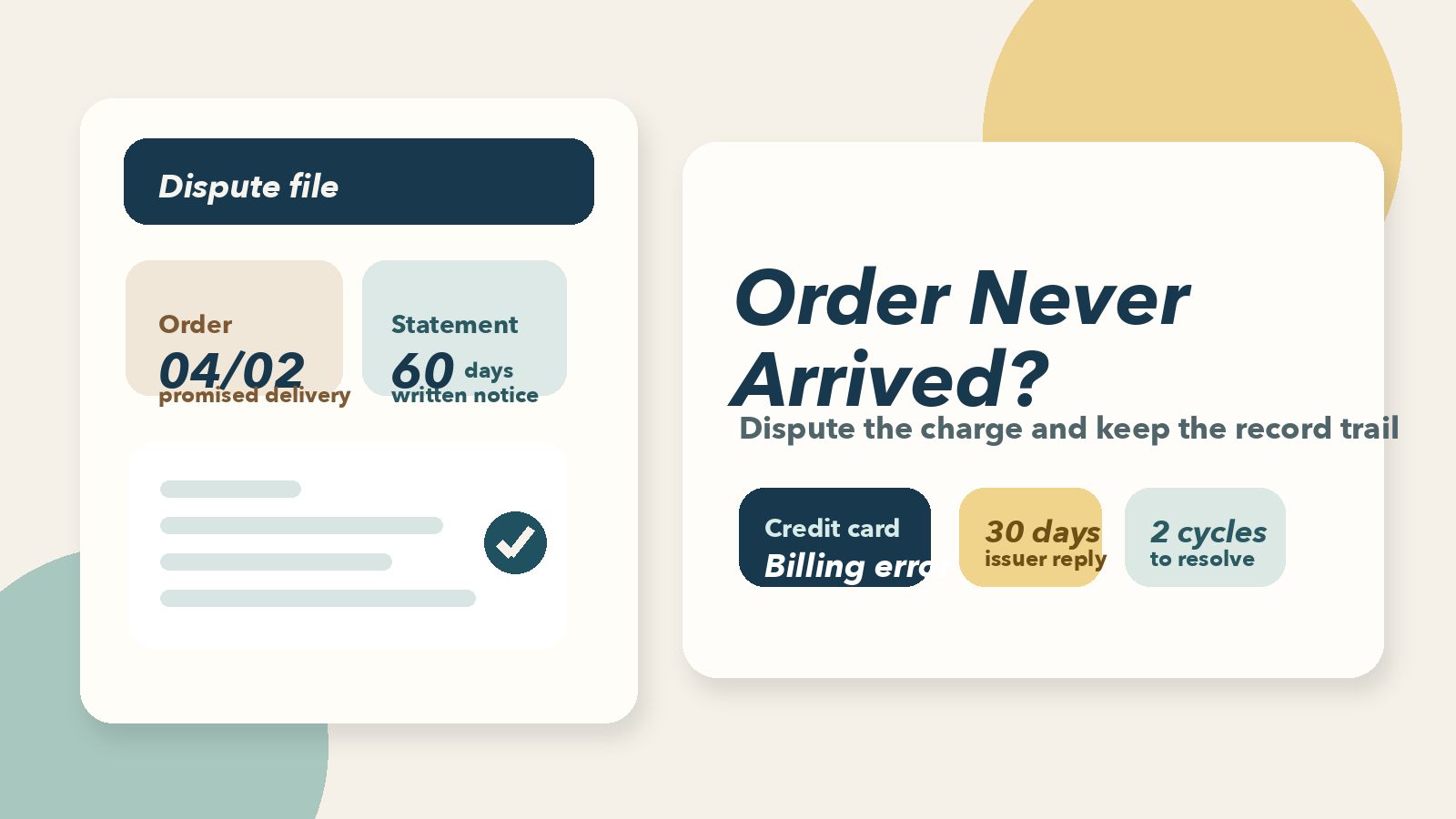
For a credit card dispute, the most important deadline is the one tied to your statement, not the one tied to the day you placed the order. The Consumer Financial Protection Bureau says you should call the card company right away, but to protect your rights you must also send a written billing error notice within 60 calendar days after the charge appeared on your statement.
The Federal Trade Commission makes the same timing point in its dispute-letter guidance. If you wait too long because you are still going back and forth with the merchant, you can weaken your position.
| Issue | What to track | Why it matters |
|---|---|---|
| Statement date | The first statement that shows the charge | Your 60-day written dispute window runs from this statement date |
| Promised delivery date | The merchant's shipping promise, delivery estimate, or revised date | Helps show the goods were not delivered as agreed |
| Merchant contacts | Emails, chats, calls, and case numbers | Shows what steps you took and what the seller said |
| Proof of order | Order confirmation, invoice, and card statement line | Ties the purchase, amount, and merchant together |
What the FTC says sellers must do when shipping is delayed
The FTC's Mail, Internet, or Telephone Order Merchandise Rule says sellers must have a reasonable basis to expect they can ship within the advertised time frame. If no time frame is stated, the rule says they generally must be able to ship within 30 days. If they cannot ship within the promised time, they must get your consent to the delay or refund payment for the unshipped merchandise.
That rule does not replace your credit card dispute rights, but it does help you frame the problem clearly. If the merchant missed its promised ship date, or never obtained your consent to a longer delay, that is useful context to document.
The records to gather before you dispute
Do not wait to assemble the file until after the issuer asks for it. Put the evidence together as soon as it becomes clear the order is not arriving on time.
- The order confirmation or invoice
- The product page, shipping estimate, or order-status page showing the promised timing
- Any revised shipping notices
- Emails, chat transcripts, or notes from calls with the merchant
- Your credit card statement showing the charge
- Any refund promise the merchant made but did not complete
If you contact the merchant, save the name of the person you spoke with, the date, and any case number. The FTC advises keeping that record and checking later that any promised credit actually posts.
How to dispute the charge the right way
1. Contact the card issuer immediately
The CFPB says to call the card company and let it know about the problem right away. Many issuers also let you file a dispute online. That can help you move quickly, but it should not be your only step if you want full legal protection.
2. Send a written billing error notice within 60 days
The written notice is the formal step that protects your rights. The CFPB says to send it within 60 calendar days after the statement with the charge was sent. The FTC says the same and recommends sending the letter by certified mail if possible, with copies of supporting records and the originals kept in your file.
Your notice should include your name, account number, the dollar amount, the date of the charge, and a clear explanation that the goods were not delivered as agreed.
3. Send it to the billing-disputes address, not the payment address
This is an easy place to make a costly mistake. Both the CFPB and the FTC note that the billing-disputes address may be different from the address where you send your payment. Use the address listed for billing errors, disputes, or inquiries on your statement, in your card agreement, or on the issuer's website.
4. Keep paying the undisputed part of the bill
The CFPB says you do not have to pay the disputed amount, or related finance charges tied to that disputed amount, while the issuer investigates. But you still need to pay the rest of the bill on time.
What should happen after you send the notice
Under CFPB guidance and Regulation Z's billing error procedures, the card issuer generally has 30 days to acknowledge your dispute unless it finishes the required resolution process sooner. It then gets two complete billing cycles, but no more than 90 days, to investigate and resolve the dispute.
If the issuer agrees with you, the charge must be removed from your bill. If it decides the bill was correct, it has to tell you why in writing and explain how much you owe and when payment is due.
Should you contact the seller first?
You can, and in many cases you probably should, especially if the merchant may fix the issue quickly. But the FTC's guidance is explicit on the sequencing risk: for most problems, contact the card issuer first so you do not lose your dispute rights because of timing requirements.
A practical approach is to do both on the same day once the problem is clear. Ask the seller for a refund or replacement, but do not let that conversation push you past the 60-day dispute deadline.
Credit card versus debit card: why the difference matters
This article is intentionally centered on credit cards because the FTC notes that legal protections for credit cards are stronger than for debit cards. Some debit card issuers voluntarily offer more protections than required, but you should not assume the process or outcome will be the same.
If you paid with a debit card, check your bank's dispute rules immediately. The general lesson still holds: document the problem fast, report it quickly, and keep copies of everything.
A simple file structure that makes disputes easier
If you buy frequently from large online retailers, create one folder per disputed order and include four items at minimum: the order confirmation, proof of the promised delivery timing, the statement line with the charge, and every merchant or issuer communication. That structure makes it much easier to answer follow-up questions later.
SpendXRay can help on the statement side by making merchant-level review easier, especially if the descriptor on the card statement is not an obvious match to the brand you bought from. It should support your dispute file, not replace the merchant documents that show what was ordered and when delivery was promised.
What to do next
- Check the first statement that showed the charge and calculate the 60-day written-dispute deadline.
- Save the order confirmation, promised delivery date, and any merchant messages.
- Contact the issuer right away by phone or online.
- Send a written billing error notice to the billing-disputes address with copies of your evidence.
- Pay the undisputed part of the bill on time and keep watching your account until the dispute is resolved.
Conclusion
When an order never arrives, the strongest position is not just having a good reason. It is having the right file and acting on time. For credit card purchases, the core workflow is straightforward: preserve the order records, document the missed delivery, notify the issuer quickly, and follow up in writing before the 60-day window closes.