
How to Build a Household Spending Calendar for Annual Bills, Renewals, and Other Irregular Expenses
Monthly budgets break when annual bills and renewal charges are treated like surprises. Here is a practical workflow, grounded in CFPB and FTC guidance, for turning irregular expenses into a trackable calendar.
Many household budgets look fine until a charge shows up that was always predictable, just not monthly. Annual subscriptions, insurance premiums, school fees, medical bills, holiday travel, warehouse-club memberships, and renewal notices often feel like emergencies only because they were left out of the month-to-month view.
That is why a spending calendar matters. The Consumer Financial Protection Bureau says to look back over several months of checking-account and credit-card history so you do not miss less frequent expenses, and its bill-calendar tool is built around tracking what you owe and when it is due. The Federal Trade Commission makes the same timing problem visible on the subscription side: mark trial deadlines on your calendar, do not ignore renewal notices, and review card statements so recurring charges do not slip by.
If you want a budget that holds up in real life, you need more than a monthly total. You need a calendar for the expenses that arrive quarterly, seasonally, annually, or only when a renewal window opens.
What a household spending calendar actually does
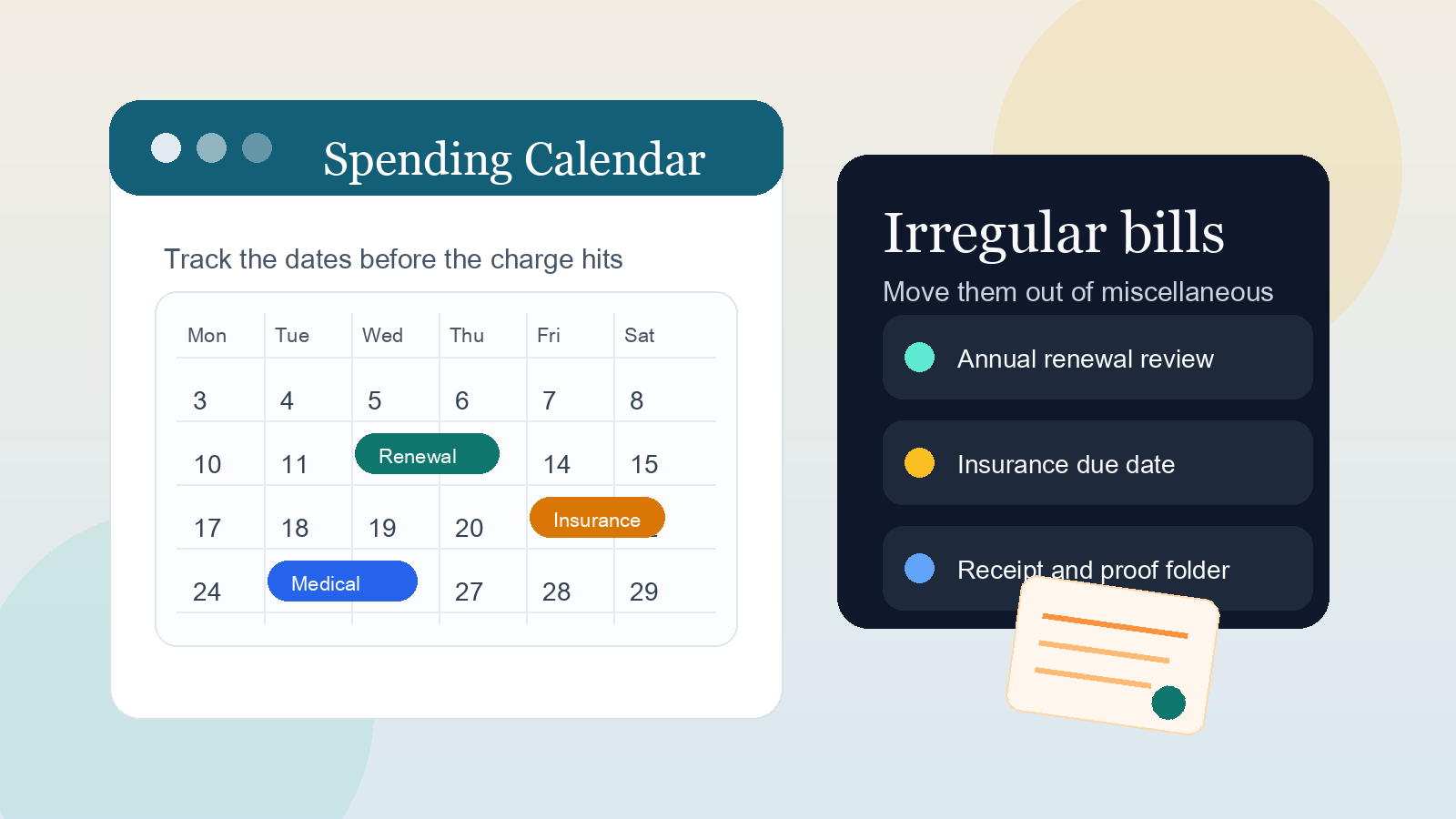
A spending calendar is not a second budget. It is the timing layer that shows when predictable non-monthly expenses are likely to hit and when you need to decide whether to keep, cancel, renew, or prepare for them.
| Expense type | Why it gets missed | What to put on the calendar |
|---|---|---|
| Annual subscriptions and memberships | They may appear only once a year and often renew automatically | Renewal month, reminder date, cancellation deadline, and expected amount |
| Insurance premiums or policy changes | They may be billed quarterly, semiannually, or through escrow changes | Due date, expected range, and review date before the premium changes |
| Medical and reimbursement-related expenses | They are uneven and easy to treat as one-off events | Service date, payment date, reimbursement status, and receipt location |
| School, activity, and seasonal costs | They cluster at specific times of year instead of every month | Expected month, estimated amount, and lead time for saving |
| Travel, holidays, and gifting | People remember them too late and then call them unexpected | Target month, working budget, and booking or purchase checkpoints |
The goal is simple: if an expense is predictable enough to name, it is predictable enough to schedule.
Why monthly budgets miss irregular expenses
CFPB guidance on assessing spending says to look back over several months so you do not miss less frequent costs like insurance payments, medical expenses, gifts, tuition, and vacations. That is the core problem with many monthly budgets: they capture the regular bills but flatten the rest into a vague miscellaneous line.
That approach weakens cash-flow planning in two ways. First, it makes a normal annual charge feel like a surprise. Second, it hides the decision points that matter most, such as whether a subscription should renew, whether an insurance increase fits the budget, or whether a medical expense still needs reimbursement tracking.
A spending calendar fixes that by showing timing, not just category totals.
How to build the calendar in practice
1. Review the last several months of real transactions
Start with the sources CFPB recommends: checking-account history, credit-card history, receipts, or a personal financial management tool. If you can review a full 12 months, that is usually the clearest way to catch annual charges and seasonal patterns. If you cannot, start with several months now and expand backward as needed.
Look for expenses that are:
- not monthly,
- large enough to disrupt cash flow,
- likely to renew automatically, or
- important enough that you would want advance notice before they hit.
2. Put each irregular expense into one line item
For each expense, record:
- what it is,
- who charges it,
- the month or exact due date,
- the last amount paid or an estimated range, and
- whether it is mandatory, optional, or reviewable.
This is also the right time to separate true irregular expenses from ordinary monthly volatility. A restaurant bill is variable spending. An annual software renewal is a scheduled event.
3. Add decision dates, not just due dates
This is especially important for subscriptions, free trials, and recurring memberships. FTC consumer guidance says to mark your calendar to cancel a free trial before it ends, to pay attention to renewal notices, and to monitor statements for charges you did not expect.
That means the most useful calendar entry is often not the billing date itself. It is the earlier review date when you still have time to decide. In practice, many households benefit from adding:
- a 30-day review date before annual renewals,
- a 7-day reminder before free-trial deadlines, and
- a monthly statement-review block for spotting recurring charges.
4. Turn the calendar into a monthly saving target
Once the annual or irregular expenses are on the calendar, divide the expected total by the number of months until the charge is due. That gives you a working monthly reserve target.
| Upcoming expense | Expected amount | Months until due | Working monthly set-aside |
|---|---|---|---|
| Annual warehouse membership | $65 | 5 | $13 per month |
| Holiday travel fund | $900 | 9 | $100 per month |
| Quarterly insurance payment | $360 | 3 | $120 per month |
These example amounts are illustrative, but the method is the important part. A predictable expense becomes much easier to absorb when it is converted into a monthly planning number before it arrives.
5. Track the proof, not just the plan
If an expense also matters for returns, taxes, or reimbursement, keep the supporting record with the calendar entry. For example, a medical purchase may need a receipt, proof of payment, and reimbursement notes. A disputed renewal may need the cancellation confirmation and the statement line showing the charge.
SpendXRay fits naturally here. It can help you review merchant-level history, recurring charges, and retailer totals, but it works best when paired with the actual source documents that explain what the charge was and whether you still expect it.
Which expenses deserve a calendar entry first?
If you do not want to map everything at once, start with the expenses most likely to create avoidable stress.
- Annual renewals that can be canceled or renegotiated.
- Quarterly or semiannual insurance payments.
- Medical expenses that need reimbursement or receipt retention.
- School, childcare, activity, and seasonal family costs.
- Holiday and travel spending that happens every year but still sneaks up.
That sequence usually gives you the biggest cash-flow improvement fastest.
Common mistakes that make irregular expenses feel random
- Reviewing only one month of card statements and assuming it represents a normal year.
- Recording the due date but not the earlier decision date.
- Treating annual subscriptions as fixed forever instead of reviewing them before renewal.
- Leaving medical or reimbursement-related purchases in a generic miscellaneous bucket.
- Assuming that if a charge is not monthly, it is not budgetable.
A simple monthly review checklist
- Review the next 30 to 60 days of calendar entries.
- Confirm which charges are fixed, which need a decision, and which need more cash set aside.
- Check your latest bank and card statements for recurring charges or amount changes.
- Save supporting documents for any expense tied to taxes, disputes, returns, or reimbursement.
- Update the calendar when a date, amount, or renewal term changes.
That routine takes less time than reacting to a surprise charge after it posts.
Conclusion
A household spending calendar is one of the simplest ways to make a budget more honest. When you review several months of real transactions, add non-monthly charges to a calendar, set reminder dates before renewals, and convert upcoming bills into monthly reserve targets, fewer expenses feel sudden and more of them become manageable.
Sources
- Consumer Financial Protection Bureau: Assess your spending
- Consumer Financial Protection Bureau: Bill Calendar
- Federal Trade Commission Consumer Advice: Getting In and Out of Free Trials, Auto-Renewals, and Negative Option Subscriptions
- Consumer Financial Protection Bureau: Budgeting: How to create a budget and stick with it