
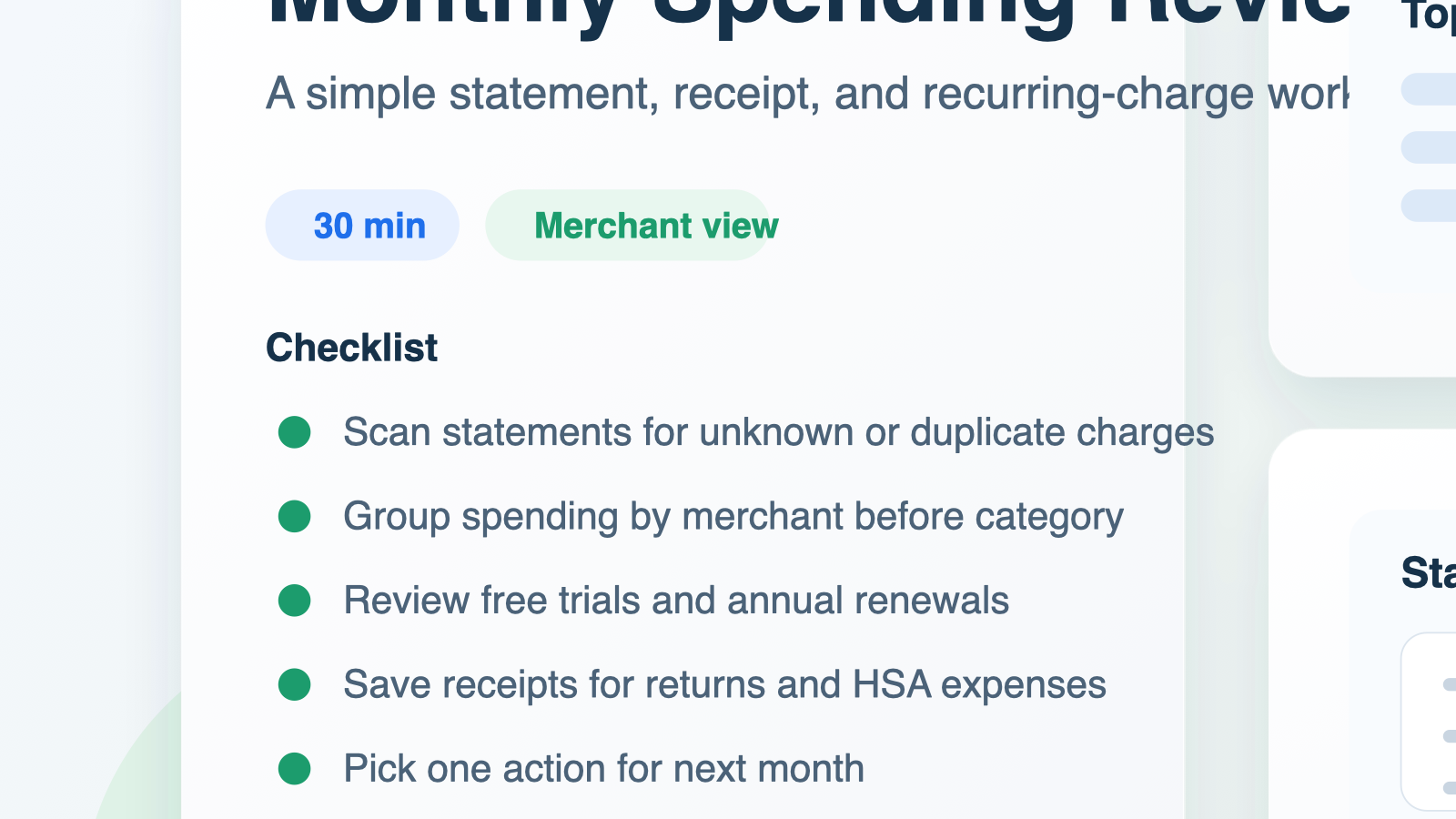
How to Do a 30-Minute Monthly Spending Review Without a Spreadsheet
A practical monthly review workflow using bank and card statements, receipts, and a bill calendar to catch overspending, recurring charges, and reimbursable purchases before they slip through.
At the start of a new month, most of the information you need is finally in one place: card statements have closed, bank transactions have settled, and subscription renewals or missing receipts are still recent enough to fix. The U.S. Bureau of Labor Statistics reported that consumer units spent an average of $78,535 in 2024, or about $6,545 a month. When that much money moves through a household, a short monthly review can catch waste, recurring charges, and missing documentation before they turn into bigger problems.
You do not need a complicated budgeting spreadsheet to do that well. For many households, a better system is a repeatable monthly review built around the records you already have: checking activity, credit-card statements, order emails, receipts, and a simple list of recurring bills.
What a monthly spending review should answer
- Where did your money actually go last month?
- Which charges will repeat next month unless you act?
- Which purchases need stronger records for returns, warranties, taxes, or reimbursement?
- Which categories or merchants are drifting higher than you expected?
- What is the one change worth making before the next statement closes?
The Consumer Financial Protection Bureau recommends reviewing checking-account and credit-card history for the last several months and saving receipts or using a spending tracker so you can see what you are really spending, not what you assume you are spending.
The four inputs to gather before you start
1. Your bank and credit-card statements
Start with the accounts where spending actually settles. Statements are the fastest way to see the full month, especially for recurring charges, refunds that never posted, and merchants you forgot about.
2. A bill calendar or recurring-charge list
The CFPB's bill-calendar guidance is simple and useful: write down what each bill is for, the amount owed, and the due date. Even if you use autopay, this list helps you spot charges that are still legitimate and charges that no longer deserve a place in next month's budget.
3. Receipts, order emails, and invoices for important purchases
A statement proves that you paid a merchant. It usually does not prove what you bought. Pull the receipts or order confirmations that matter for returns, warranties, medical reimbursement, or year-end records.
4. Last month's budget or category targets, if you use them
You do not need a formal zero-based budget for this review. A short list of expected ranges is enough: groceries, household, eating out, subscriptions, transportation, and any category that tends to drift.
The 30-minute monthly review workflow
Minutes 1 to 5: Scan the full month for obvious exceptions
- Look for duplicate charges, unusually large purchases, and refunds that never appeared.
- Mark merchants you do not recognize immediately so you can investigate while the charge is still fresh.
- Flag any subscription or membership charge that you forgot was still active.
If a charge involves a free trial, auto-renewal, or a cancellation that did not stick, the FTC advises reviewing the merchant's cancellation steps, keeping your cancellation records, and watching later statements to confirm the billing actually stopped.
Minutes 6 to 12: Group spending by merchant before you group it by category
Merchant-level review is where many households find the useful patterns. A category like shopping can hide whether the overspend came from one retailer, repeated convenience purchases, or a single large restock.
- Add up the merchants that appear most often.
- Separate one-time major purchases from recurring everyday spending.
- Highlight merchants tied to household staples, subscriptions, and medical purchases.
This is the point where a tool like SpendXRay can help, because the review gets easier when purchases are already organized by retailer and item rather than buried in raw statement lines.
Minutes 13 to 18: Compare recurring charges against your current priorities
Recurring costs deserve their own pass because they can survive long after their value fades.
| What to flag | Why it matters | What to do next |
|---|---|---|
| Free trial that turned into a paid plan | Promotional pricing and auto-renewals often change the real monthly cost | Check the renewal terms, cancel if needed, and save proof of cancellation |
| Two services solving the same problem | Overlap is harder to notice when charges hit on different dates | Keep the better service and remove the duplicate |
| Annual renewal you forgot about | Large once-a-year charges can distort cash flow | Add the next renewal date to your bill calendar now |
| Price increase on an existing subscription | The cost you agreed to last year may not be the cost you are paying now | Review the notice, downgrade, negotiate, or cancel |
Minutes 19 to 24: Pull out purchases that need stronger records
This step matters because the statement alone is often not enough later. Keep better supporting records for:
- Items you may return or exchange
- Electronics or appliances with warranty coverage
- Medical purchases that may be HSA- or FSA-eligible
- Large household purchases you may need to reference for insurance or taxes
If you use an HSA, IRS Publication 969 says you must keep records sufficient to show that distributions were used only for qualified medical expenses, that those expenses were not previously reimbursed from another source, and that they were not taken as an itemized deduction. Plan administrators can have their own documentation requirements, so keep the detailed receipt or order record, not just the card statement.
Minutes 25 to 30: Decide on one concrete adjustment
Do not end the review with a vague goal like spend less next month. Pick one action that changes the next statement:
- Cancel one low-value recurring charge
- Set a cap for one fast-growing merchant or category
- Move one reimbursable medical purchase into a dedicated folder
- Add one annual renewal date to your calendar
- Create one merchant note you will reuse next month
One completed action is more useful than a perfect spreadsheet you never revisit.
Signals that your system needs to change
- You regularly recognize charges only after the statement closes.
- You cannot tell which retailer drove a shopping-heavy month.
- You have the statement but not the receipt for purchases that matter later.
- You keep paying for services you thought you canceled.
- You know your total spend, but not the merchant or item patterns behind it.
When those patterns show up, the fix is usually not more complexity. It is better visibility into merchants, recurring charges, and the purchases that deserve documentation.
A simple monthly checklist you can reuse
- Open every checking and credit-card statement for the month.
- Mark unknown, duplicate, or unusually large charges.
- Review top merchants and compare them to last month.
- Check recurring charges against your current priorities.
- Save receipts or order records for returns, warranties, and medical reimbursement.
- Choose one action before the next month starts.
Conclusion
A monthly spending review does not need to be complicated to be useful. If you can review settled transactions, spot recurring charges, and keep the right records for the purchases that matter, you will understand more about your money than most people do from a budget template alone.
The goal is not to admire the data. The goal is to make the next month cleaner than the last one.
Sources
- U.S. Bureau of Labor Statistics: Consumer Expenditures--2024
- Consumer Financial Protection Bureau: Assess your spending
- Consumer Financial Protection Bureau: Track your spending with this easy tool
- Consumer Financial Protection Bureau: Bill Calendar
- MyMoney.gov: Spend
- Federal Trade Commission: Getting In and Out of Free Trials, Auto-Renewals, and Negative Option Subscriptions
- Internal Revenue Service: Publication 969, Health Savings Accounts and Other Tax-Favored Health Plans